INDIGENOUS BLACK NORTH AFRICANS
Fulani Tribe. Same pastoralist culture, still wear the ostrich feather to this day
Taken from the tomb of Rameses III Festival of Min where we see the /TmHw/ Tchemehu (Libyans), Part of a procession of royal attendants, Medinat Habu. Ramesses III Usermaatre-meryamun at his funerary temple on the West Bank, 20th Dynasty. The pigment on the walls is extremely well preserved when compared to most other temples, and presents an idea of how colourful the temples of ancient Kemet once were. It also gives a clear indication of the complexion of the people. Below we see modern day Fulani who still inhabit Libya as well as countries like Nigeria, Guinea, Senegal, and Mali, as well as in parts of Central Africa and Sudan.

In ancient times various Libyan tribes coexisted in the Sahara Desert including the Meshwesh, Temehu, and Tehenu. During the 23rd and 24th Dynasty these Libyan Kings would take control of Lower Kemet which created a fractured nation and would result in decades of war between the Kushite-Wasetian coalition whose strong hold was Waset (Thebes) in Upper Kemet and the Sais-Greek-Assyrian forces of the North in the Delta and city of Memphis.
luput II was a Neswet (Pharaoh) of the 24th Dynasty. The 23rd and 24th dynasty's of Kemet (Egypt) was a regime of Meshwesh Libyan kings, who ruled Lower Kemet and the Delta between 880 and 734 BC. Iuput II was one of Kemet's rulers of Libyan origin who was forced to submit to the Kushite ruler King Piye when Piye came to the defense of Kemet around 728 BC.
Relief of King Iuput II
Tchemehu (Temehus): This group is often identified with the broader Libyan populations and was organized into two main subgroups, the Thnw (Tehenu) in the North and the Nhsj (Nehesy) in the South. The Tchemehu were seen as a significant part of the C-Group culture, which included distinct pottery styles and burial practices. They were closely associated with pastoralism and cattle herding, emphasizing their agricultural lifestyle.
Tehenu (Thnw): The Tehenu, specifically, were a subgroup of the Tchemehu and were located in the northern regions of Libya. They were characterized by their unique cultural expressions, such as distinctive dress and adornments, including pointed beards and feathered headdresses. The Tehenu are often depicted in ancient Egyptian art, showcasing their interactions with the Egyptians. They are belived to be a population who migrated from the near East into North Africa and settled mostly along the coastal regions in waves starting around 1700 BCE. Their cultural traits were different from those of the southern Nehasyu people, indicating a diverse ethnic landscape within the Tchemehu classification.
Meshwesh: The Meshwesh, also known as the Meshwesh or Mshwesh, were an ancient group that inhabited the regions of North Africa, particularly Libya. They are often considered a branch of the broader TmHw (Temehus) cultural group, which also included the Tjhnw (Tehenu) of Nothern Libya. The Meshwesh are often depicted in Egyptian art with specific features, such as long hair and elaborate headdresses, which set them apart from other groups like the Tjhnw.
The Toubou: The Toubou or Tubu (from Old Tebu, meaning "rock people") are an ethnic group native to North Africa that inhabit the central Sahara in northern Chad, southern Libya, northeastern Niger, and northwestern Sudan. They live either as herders and nomads or as farmers near oases. Their society is clan-based, with each clan having certain oases, pastures and wells. The Toubou are belived to be the ancestors of the ancient Tchemehu.
The Tuareg: The Tuareg, also known as the "blue people" due to their traditional indigo-dyed attire, are a nomadic Berber people primarily inhabiting the Saharan region. They are known for their distinct culture, language (Tamasheq), and unique social structure, which often involves a matrilineal system. The Tuareg have historically been camel herders and traders, navigating the harsh desert landscape with remarkable skill. Their physical characteristics have been noted to include a svelte stature and fine features, with some descriptions indicating that their traits may align more closely with those referred to as "Negro". They are also believed to be the ancestors of the ancient Libyans.
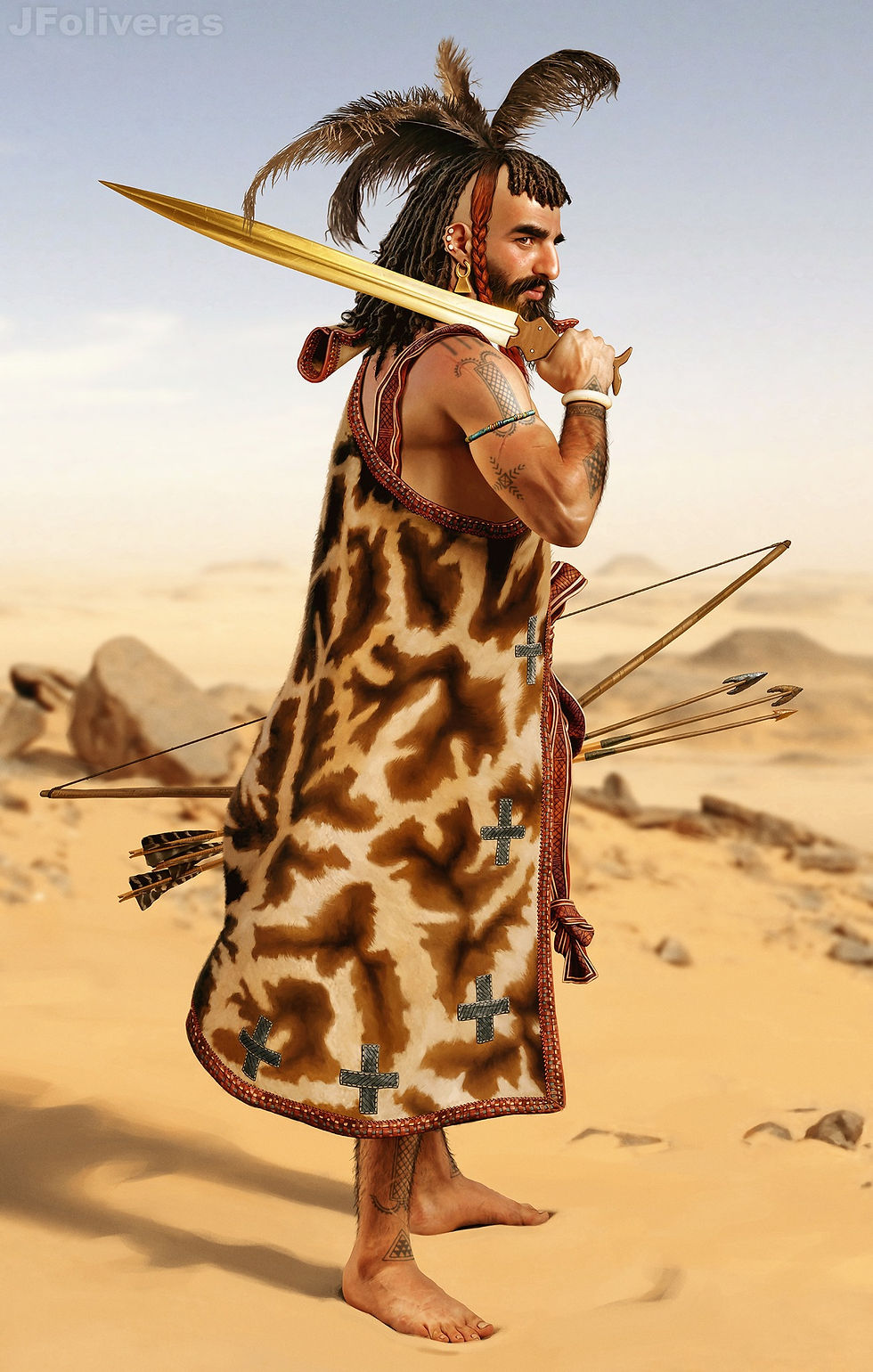
While many claim that Eurasians settle north Africa around 8,000 BCE with various waves of back-to-Africa migrations, these were dark-skin populations; not the fair-skinned populations whom manh people associate with North Africa today. The Fulani are among these back-to Africa migrants whos genetic markers tie them to areas of modern day Syria and Palestine. The "Eurasians" who migrated into North Africa around 8000 BCE were indeed part of a dark-skinned population. At that time, the gene for lighter skin had not yet been introduced into the human gene pool. The early migrants, who moved into the Egyptian Sahara, were likely to be closely related to the indigenous black-skinned populations already residing in the region. The later fairskiined populations of Aamu (Asiatics) and Tjhnw (Nothrn Libyans) would come later around 1700 BCE. These back-to-Africa migrations would eventually lead to the Hyksos Invasions known as the First, Second and Third Intermediate Periods in ancient Egyptian records.

The Asiatic Invasion of Ancient Kemet (Hyksos Invasion): https://www.knowthyselfinstitute.com/post/the-asiatic-invasion-of-ancient-kemet-hyksos-invasion
The evidence indicates that during this period, the Sahara was experiencing a phase of increased greenery, allowing for the migration of these populations from the south towards the northern regions. As a result, the encounter between the incoming Mediterranean groups and the local inhabitants would have included significant cultural and genetic interactions.
Herodotus visited the Libyan east coast around 450 BC and, in his book, The Histories, described the Toubou as Ethiopian or Abyssinian. The historian located them from what is now Fezzan in Libya through Chad to Niger and into Sudan and Central Africa. The Sultan of the Toubo tribe, Zulai Mina Saleh, said: “We are the people of Africa. We are all black, but our features are different. Our faces, noses, teeth and language also differ.”
Fulani women Girls dressed in traditional garb pose for a group picture during a Toubou (or Tebu) cultural festiv Two Amazigh women in full traditional garb Amazigh Women Two Amazigh women in full traditional garb A young Berber boy. Photo Credit: TWR.org A beautiful Amazigh girl from North Africa Amazigh women in full traditional garb Amazigh women in full traditional garb A tuareg family
Indigenous Black North Africans
Ancient historical data and recent scientific evidence assert that the Toubou were among the first to settle in the Green Sahara prior to its desertification. At this time the Sahara was a lush tropical region which produced a people with tropical features not unlike those of Nilotic Africa. Their history in some habitats may well be over 30,000 years old. According to Abu Kala Zen, “it is likely that the Toubou were the descendants of prehistoric cattle herders that settled in the area and were able to resist and adapt to the desert.”
Sufi Alchemy- Are the oringal Berber Black Africans?
The ancient history of the Toubou people is unclear. They may be related to the 'Ethiopians' mentioned by Herodotus in 430 BCE, as a people being hunted by the Garamantes, but this is speculative, as Jean Chapelle argues. Furthermore, scholars such as Laurence P. Kirwan stress that the Garamantes and the Toubou seem to occupy the same lands. Which spans from the Fezzan (Phazania) as far south as Nubia. Further evidence is given by Harold MacMichael states that the Bayuda desert was still known as the desert of Goran; a name as MacMichael has shown, connected with the Kura'án of today. This reaffirms that the Kura'án (Goran) of today, occupy much of the same territory as the Garamantes once did.
The 6th-century Roman poet, Corippus, in his book Johannis, describes the Berbers as “facies nigroque colorus” which means “faces of the black colour”. In the same century, Procopius in Book IV of History of the Wars discussed the difference between the Vandals who had settled in North Africa and the Moors who in Europe became known as the Blackamoors. Procopius says that the Vandals were not “black-skinned like the Maurusioi (Moors)” .
The tribes he classified as Maurusioi are those now described as ancient Berbers. They include the Numidians, Masaesyle, Gaitules, Massyles, Masmuda and Mezikes. asr Khusrau, an 11th-century Iranian also described the Masmuda soldiers of the Fatimid dynasty as “black Africans”. Arab and by extension, the Islamic invasion of North Africa, was from around the 6th-century but after Christianity had permeated the region for half a millennium which Arabized many in the region.
The Fulani Tribe are another ancient population who populate southern Libya. They are the same pastoralist culture that existed there thousands of years ago, many of which migrated to the region from ancient Egypt. They still wear the ostrich feather to this day.
Sources:
Oyeniyi, Bukola Adeyemi. The History of Libya. Santa Barbara: Greenwood, 2019.
The Whitewashing of ancient North Africa:
Follow our YouTube Channel:
"I have not spoken angrily or arrogantly. I have not cursed anyone in thought, word or deeds." ~35th & 36th Principals of Ma'at


Comments